
Wisconsin Rapids followed this pattern. The first white settlers in the area came to make shingles to sell to growing cities downriver. They established a saw mill at a rapids, where they could use the Wisconsin River's abundant water power. Soon there were fleets of lumber rafts headed downriver every spring. Rafting dwindled as area forests were exhausted and railroads put an end to rafting on the Wisconsin by 1900. The extensive damming of the Wisconsin River started soon after that, converting the deadly rapids into industrial powerhouses. Today, lumber rafting is a nearly forgotten chapter in history and the rapids that claimed so many lives are marked by a series of dams.
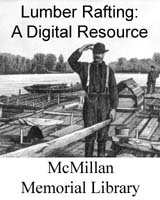
Raftsman's View of the Wisconsin River. In 1886, the Arpin family of Grand (later Wisconsin) Rapids sent a fleet of of rafts down the river during the spring high water. Near Wisconsin Dells they were joined by pioneer photographer H.H. Bennett, who documented their life as they passed through the Dells and on to the Mississippi River. This book is a collection of 37 engravings based on those photographs. Chisholm Bros. published this work as part of "Chas. Frey's Original Souvenir Albums of All American & Canadian Cities & Sceneries Souvenir Books." Though this book is rare, it contains engravings of some of Bennett's most famous photographs. It does not include the entire "Raftsman" series of photographs Bennett took. The images are housed on the Library's Flickr site.
From: 100 Years of Pictorial & Descriptive History of Wisconsin Rapids, Wisconsin by T.A. Taylor (1934-1939). Local historian, politician and photographer "Tom" Taylor compiled a large book of photographs and another of explanatory text, which he donated to the Library. Taylor composed the first three selections himself. The other four selections are recollections of raftsmen. The entire book is available on this site.
From: History of Wood County compiled by George O. Jones, Norman S. McVean and others : illustrated. H. C. Cooper, Jr. & Co., 1923. Chapter VI -The Lumber Industry deals with the lumber industry and rafting. The entire book is available online and is in the public domain.
From: The Wisconsin river : an odyssey through time and space by Richard D. Durbin. Spring Freshet Press, c1997. This material is copyrighted and used here with the author's permission.
-
Lumber Industry p. 20-22
-
Rafting Lumber p. 35-38
-
Booms p. 45
-
Rivermen p. 57
- Rapids p. 215-216
From: Lumbermen on the Chippewa by Malcolm Leviatt Rosholt. Rosholt House, c1982. This material is copyrighted and used here with the copyright holder's permission. The entire book is available on-line. Of special interest are p. 137-146.
From: The Wisconsin logging book, 1839 - 1939 by Malcolm Leviatt Rosholt. Rosholt House, c1980. This material is copyrighted and used here with the copyright holder's permission. The entire book is available on-line. Of special interest are: River rafting days, p. 190-194; Making a raft, p. 195-201; The risks they took, p. 202-205; and Pilot fees and charges, p. 206-211
From: River City Memoirs III by Dave Engel. South Wood County Historical Corp., c1985. Grand Rapids and The Centralia Dam , p. 8-14.This material is copyrighted and used here with the author's permission.
From: Camera Man of the Dells by Miriam Bennett. p. 36-42. This unpublished manuscript is copyrighted and a section is used here with the copyright holder's permission.
From: Pioneer photographer, Wisconsin's H. H. Bennett by Sara Rath.; photos. selected by Rick Smith ; with an afterword by Miriam E. Bennett. Tamarack Press, c1979. Bennett and his long time desire to photograph lumber rafting. This material is copyrighted and used here with the author's permission.
H.H. Bennett - A brief biography of the photographer whose work is the basis for the engravings in Raftsman's View of the Wisconsin River.
Grand Rapids in 1874 - This bird's eye view of Grand Rapids (now Wisconsin Rapids) shows how a small river town converted logs to lumber rafts, demonstrating the importance of water power.
Off-site resources
-
Our Country Our Story Portage County Wisconsin - When lumber was king. This chapter covers logging and lumbering in neighboring Portage County. The entire book is available on-line.
-
Lumber Rafting on Wisconsin by Simon Augustus Sherman. Also available from the Wisconsin Historical Society.
- Personal experiences of a Wisconsin River raftsman by Ceylon Childs Lincoln.
Sources used:
-
Empire in pine : the story of lumbering in Wisconsin, 1830-1900 / by Robert F. Fries. Wm. Caxton, c1989. (Chapter 5, Milling and marketing, p. 60-83.)
-
History of Wood County, Wisconsin compiled by George O. Jones, Norman S. McVean and others : illustrated. H. C. Cooper, Jr. & Co., 1923. Available on-line.
-
Lumbermen on the Chippewa by Malcolm Leviatt Rosholt. Rosholt House, c1982. Available on-line as part of the Malcolm Rosholt Collection.
-
Mississippi basin pioneer : from logging and lumber operations at the headwaters of the Mississippi River to flood control, water regulation and marsh land reclamation near its mouth / reminiscences of A.L. Arpin. Arpin, 1962.
-
100 Years of Pictorial & Descriptive History of Wisconsin Rapids, Wisconsin by T.A. Taylor, 1934-1939.
-
Pioneer photographer, Wisconsin's H. H. Bennett by Sara Rath.; photos. selected by Rick Smith ; with an afterword by Miriam E. Bennett. Tamarack Press, c1979
-
River City Memoirs III by Dave Engel. South Wood County Historical Corp., c1985.
-
Story of a raftsman’s life on the Wisconsin River. Portland, Me. : Chisholm Bros., [between 1887 and 1899].
-
The Wakelys, Point Basse and Wisconsin as they knew it by Bonnie Wolslegel. Historic Point Basse, Inc, 2003.
-
The Wisconsin logging book, 1839-1939 by Malcolm Leviatt Rosholt. Rosholt House, c1980. Available on-line as part of the Malcolm Rosholt Collection.
-
The Wisconsin river : an odyssey through time and space by Richard D. Durbin. Spring Freshet Press, c1997.
-
Wisconsin: stability, progress, beauty by Fred L. Holmes. The Lewis publishing company, 1946. (Chapter 52 - Lumbering, vol. 2, p. 85-111).
-
Camera Man of the Dells by Miriam E. Bennett, an unpublished manuscript.
-
A Wisconsin pioneer in photography by A.C. Bennett. Wisconsin Magazine of History, March 1939, p. 268-279.
McMillan Memorial Library wishes to thank the authors and copyright holders who graciously granted us permission to use their material. Without their willing participation, this resource would not have been possible. The Library also wishes to acknowledge the assistance provided by the Wisconsin Historical Society in researching this topic.